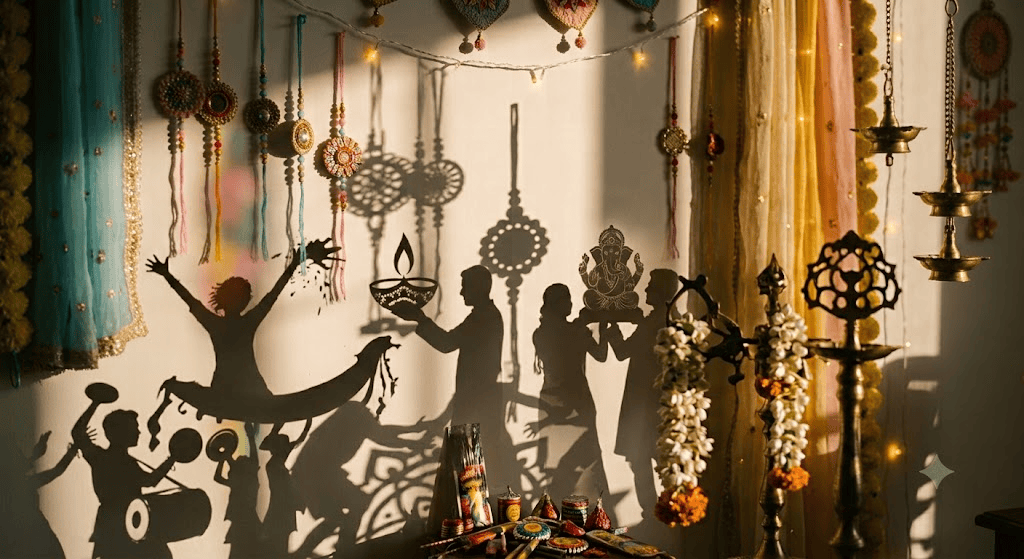
“As the sun rose, there were sounds of vehicles zooming in; people gathering in my neighbour’s house, men and women all dressed in traditional attire, chattering and laughing. The sound of anklets and bangles made me sit down and think—what day was it? And then it dawned on me that it was the day of “Rakshabandhan”, and my heart sank again.”
Entering an Indian home on a festival day, the smell of tempting food would waft from the kitchen; people would be decked up in traditional wear, especially women, who would be wearing their special jewellery; the house would look decorated. In India, festivals are a community affair, not just a family celebration, and the euphoria of each festival is found in the air of the country. Extended families love coming together to celebrate each and every one of them. The joy and happiness are so infectious that communities inconspicuously become a part of them.
Till a few years back, I was also one of those who would have a deep enthusiasm for the celebrations. I would be gearing up for festivals days prior; spending time, buying clothes, home décor, planning the food, and getting the home ready. As I grew up in various parts of India, I had deep enthusiasm for celebrating different festivals from childhood, which grew stronger as I grew.
As Hindu’s believe “औरत घर की लक्ष्मी होती है, जो घर में सुख, शांति और समृद्धि लाती है।” and I really took this seriously, which made me put in an effort to make the festival days not only feel but also look celebratory.
2022 was a shattering year, when life threw me into the deep, dark hole of becoming a grieving mother.
And everything felt meaningless.
Grief consumed not only my physical being, but it also took away all the zeal and enthusiasm that I had for life.
Till 2022, I dared to face the challenges that life threw at me but this was not a challenge or a hurdle to cross with, this was not the usual order of life.
This was not something that I could not overcome nor was it something I could get over with; it was a pain that I had to learn to live with till the last breath.
Slowly, I started learning how to handle my everyday routine life with the pain and grief of losing someone who was not only an integral part of my life, but also my biggest supporter in everything.
I learnt how to live without those daily talks and discussions, without those hugs and the time together.
Then came festival days….
My initial reaction to them was to run away on those days; I did do that for one or two of them.
But then India, being a culturally rich country, has a plethora of festivals; so how many can you run away from?
The next option was to not celebrate them and sit at home with doors and windows closed. Did that help?
No, because you would still see the house and shops adorned with beautiful torans, the festive vibe in people; you could hear children and adults talking, laughing, as I had realised festivals in India are a community affair.
I could not shut them out by just keeping my doors closed. Thus, after two years, I realised there is no running away from festivals that keep visiting every year. There are also expectations from close family and friends who, after two years, did start inviting, they had been supportive but equally sad to see the version of me staying away from everything.
They were encouraging and hoping that being a part of their celebrations might make me forget my grief for a while. Disappointing them seemed unfair, especially when I knew their efforts came from a place of genuine love and concern.
And began a struggle with myself on how to bear those days.
I started taking small steps towards the celebratory days. It started by mentally preparing myself for the days to come; for instance, if a festival is due on Sunday, I start telling myself at least 15 days before the festival, “This is the festival coming; be prepared. You would see happiness and festive preparation around. Don’t start overthinking; it is just for a day or two.”
I started creating small rituals with my son, buying his favourite sweets (it still hurts and breaks my heart) and distributing it with some children, either from the neighbourhood or from the underprivileged strata.
Keeping a plate for him; if the family is celebrating together, the empty chair is painful, but acknowledging him makes the pain bearable.
Sharing some funny anecdotes about him with the family, something which makes everyone laugh and does not make them scared of the grief.
Every festival now has a small little ritual with him, and now, four years down the line, these small little rituals are the most important part of the festival for me. They make the days less heavy, and can hold me on such days.
I have learnt that being in grief does not mean not celebrating festivals; on the contrary, it means celebrating them with his love and memories.
The pain and longing that come with the festivals have not lessened, but these baby steps that I have started taking have made the days a little more acceptable.
I have come to terms with the fact that celebrating festivals with family and friends does not mean that I have forgotten my son; instead, today I believe that he is there along with me, celebrating it through my eyes and actions.
This is how I have learnt to navigate festivals, not by leaving my grief behind but by making room for the love, memories, and grief all together on one plate. And somehow, through these little rituals, I feel that my son is still a part of every celebration.
“Navigating Loss Through Festivals: Making Room for Love, Memories, Grief and Joy”